

Carl Adolf BUCHNER (1921 – 2003)
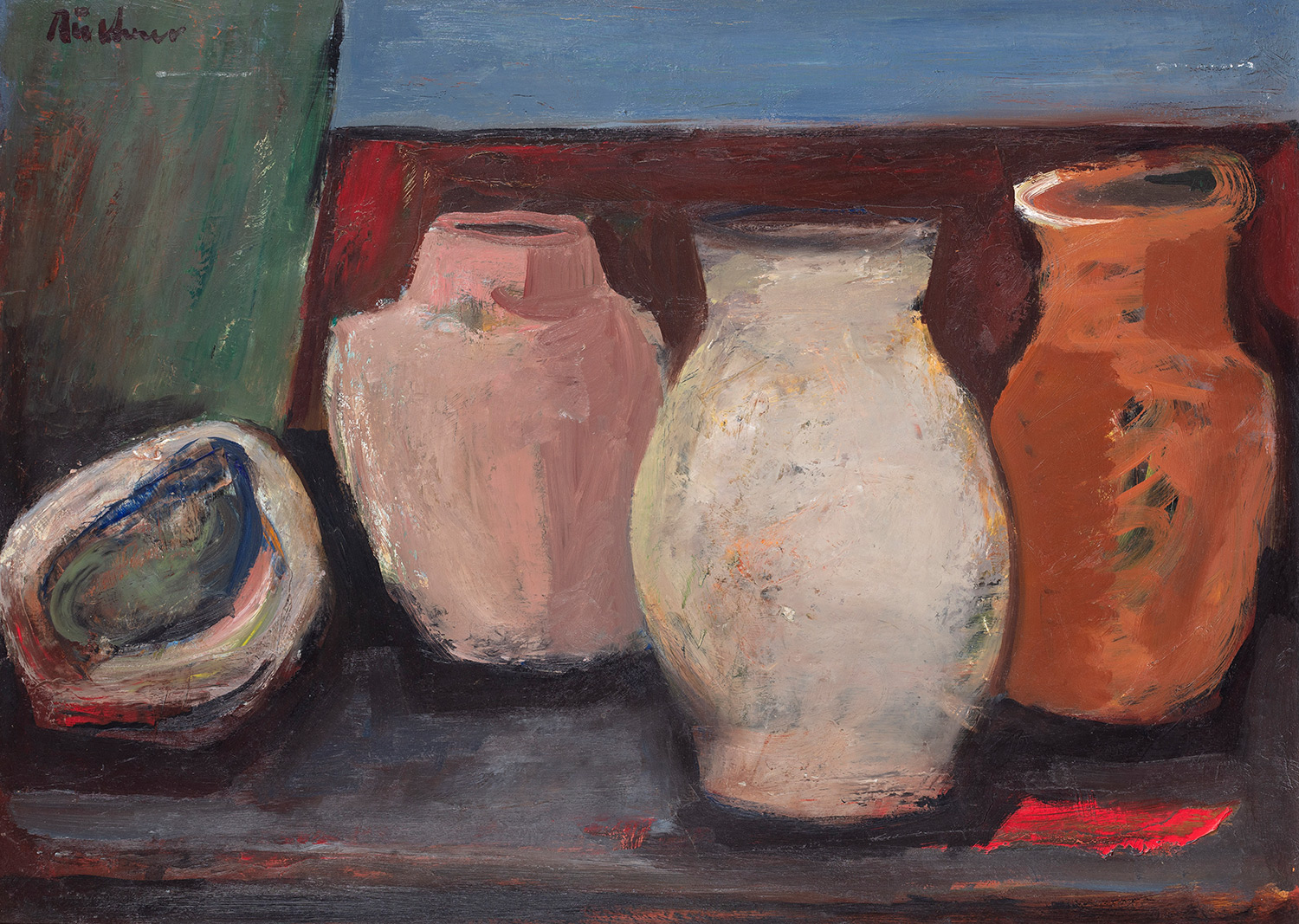
Still Life With Urns
year unknown
oil on canvas
size unknown
BIOGRAPHY
Born in Somerset East, Carl Büchner studied History of Art at the University of the Witwatersrand and Fine Art at the Witwatersrand Technical College School of Arts and Crafts under Eric Byrd and Maurice van Essche.
He qualified as a teacher and started his teaching career at the Pretoria Art Centre with Walter Battiss and Le Roux Smith Le Roux. After teaching at numerous Transvaal (now Gauteng) schools, he worked as an Art Inspector for the Cape Education Department in Grahamstown (now Makhanda), was Principal of the Stellenbosch Art Centre, and lectured at the Michaelis School of Fine Art.
He was a Trustee of the South African National Gallery for many years and an art critic for Die Burger and The Cape Times. He participated in numerous solo and group exhibitions, including the 1956 and 1960 Quadrennial Exhibitions, the 1982 Cape Town Triennial, and the 1963 São Paulo Biennale. He also won the fifth annual Artists of Fame & Promise competition in 1963. He retired from teaching in 1970 to become a fulltime artist and painted until his death in 2003.
The human figure featured prominently in Büchner’s paintings, with slightly elongated figures nostalgically portrayed through expressionistic distortion.
‘He made frequent use of the palette knife, scrumbling one colour over another to create textural and tonal variation in the flat colour areas which described both space and mass,’ writes Esmé Berman. ‘In later works Büchner began to model with his brush; the previously flat application of colour was replaced by modulated strokes of juicy paint and the suggestion of three-dimensional plasticity was heightened by the elimination of his customary linear accents.
‘He seemed to have been much influenced during his 1957–58 tour of Europe by the contemporary Italian school, particularly Morandi; and, in common with the latter, he gave most of his attention to still-life during the period which followed. Also like Morandi, his still-life groups, though simplified and monumentalised almost to the point of abstraction, were never merely assemblages of abstract forms: the elements remained objects, retaining their identification with humanity and the human purposes they served.’
Büchner’s paintings can be closely associated in style and subject matter with his mentor and colleague Maurice van Essche.
Carl Büchner is represented in numerous public collections throughout South Africa.