

LUCY MARY WILES (1920 – 2008)
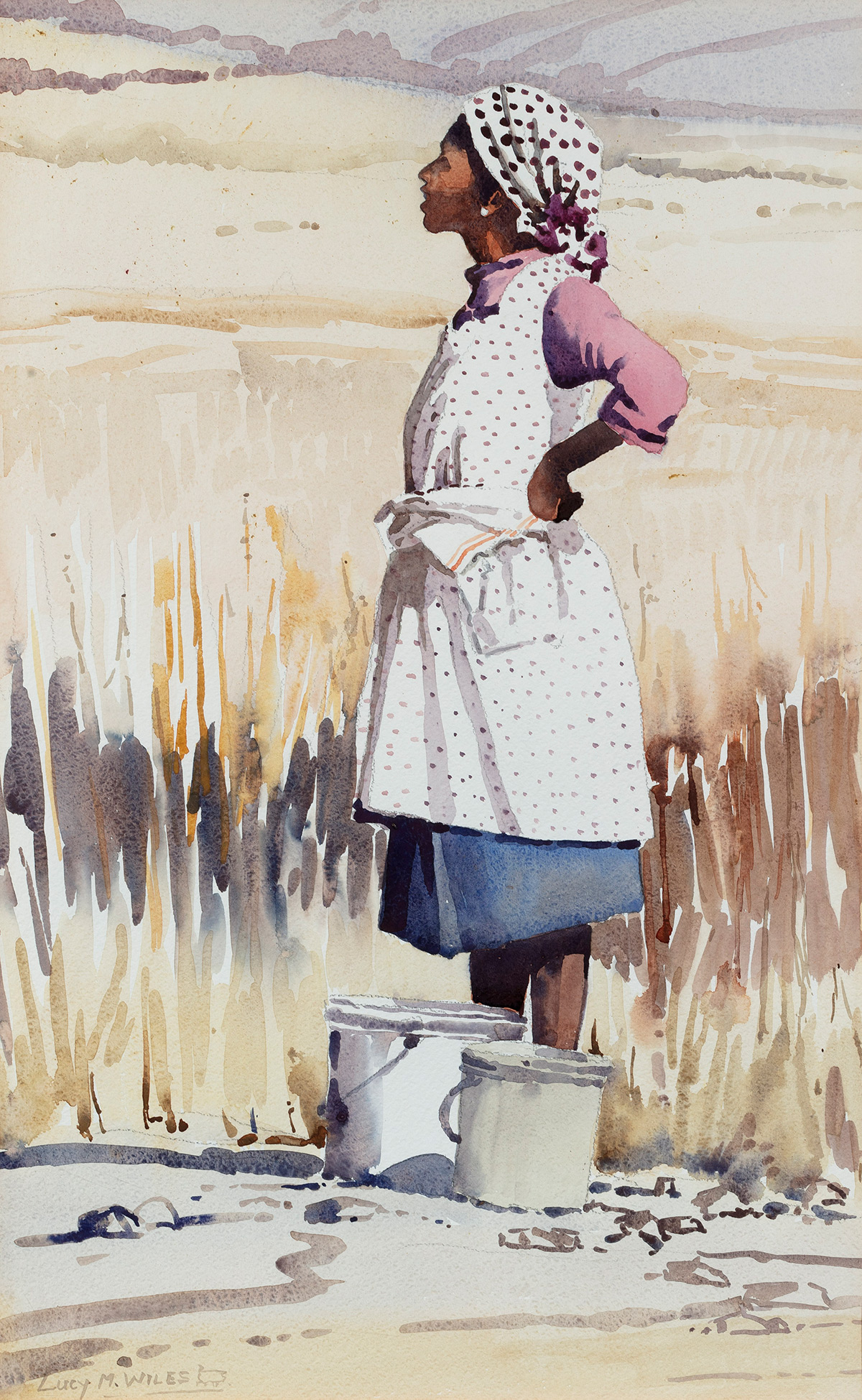
The Water Carrier
1966
watercolour on paper
38 x 59 cm
BIOGRAPHY
Lucy Mary Wiles (née Mullins) was born in Johannesburg at attended Barnato Park School. She originally trained as a nurse, but went on to study art at the Johannesburg School of Art and Natal Technical College.
Her earlier works are signed with her maiden name, Lucy Mullins. Xhosa Woman, in the Campbell Smith Collection, is from this phase of her career. It depicts a young woman wearing a traditional ochre blanket-wrap and a beaded headband. Her head is covered in a conventional colonial-style ‘doek’.
Through her marriage to Brian Wiles in 1953, Mullins became a member of the Wiles family, well known in the Knysna region of the Eastern Cape, who have been artists for several generations. The style and range of subjects taken up by the artists of this family have tended to be conventional, ranging from landscape to portraiture.
Wiles continued to work within the colonial-era genre of the ‘native study’. This genre emerged during the 1920s and 30s, largely as a result of efforts by Leo François (1870–1938), President of the Natal Society of Artists, and others who were keen to establish a ‘South African national school’ and tried to generate an interest in figure studies as an antidote to the dominance of local landscapes at annual exhibitions. This approach was incentivised when Karl Gundelfinger, a Durban patron, established the Gundelfinger Prize for the best painting of ‘native life’. The prize was worth 20 guineas. With the growth of its popularity with patrons, the genre was also taken up by notable Black artists like Gerard Bhengu and George Pemba.
Artworks by Wiles are held in in the Queenstown Art Gallery, Eastern Cape and the William Humphreys Art Gallery, Kimberley.