

Nicholos HLOBO (b. 1975)
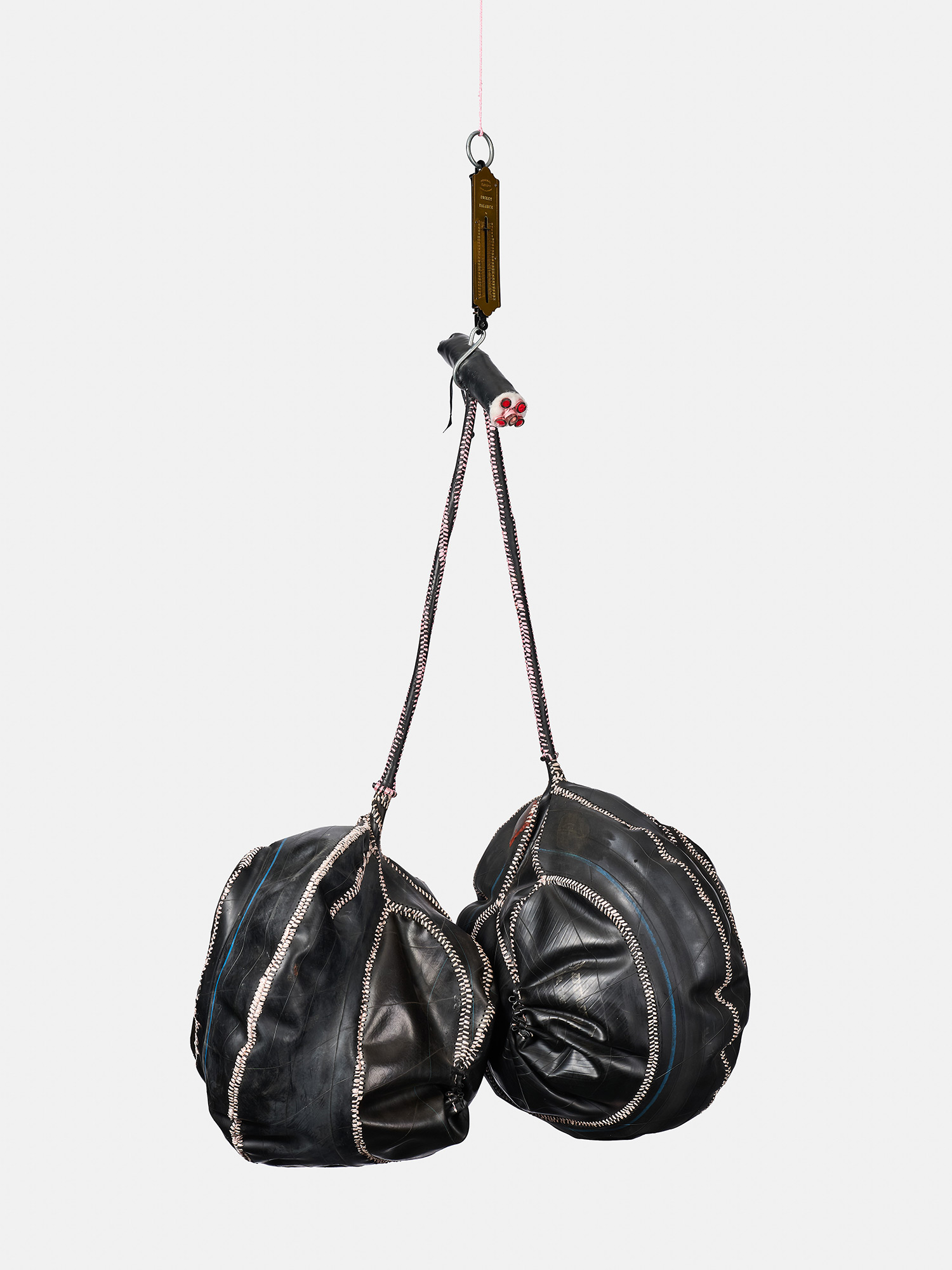
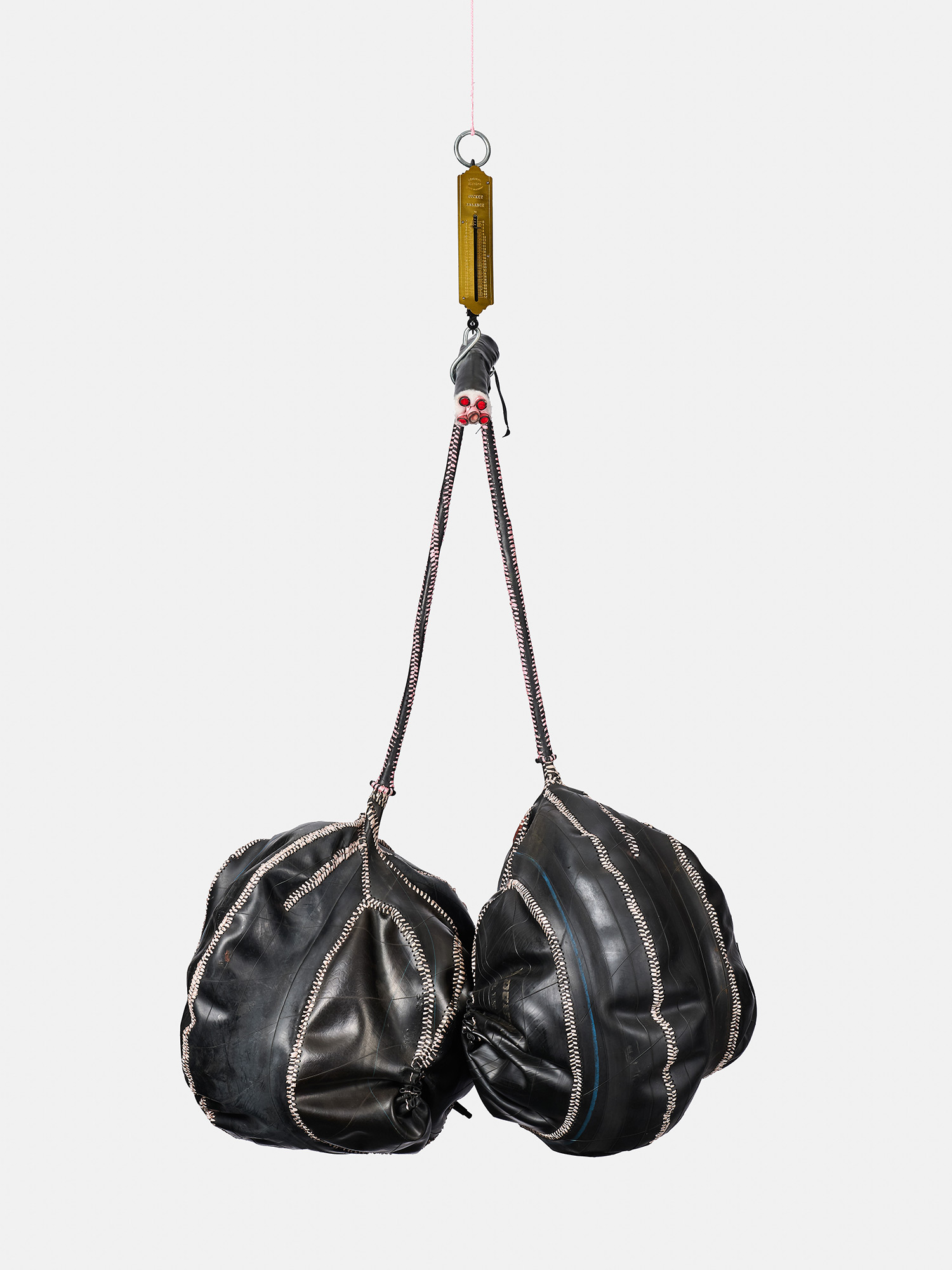
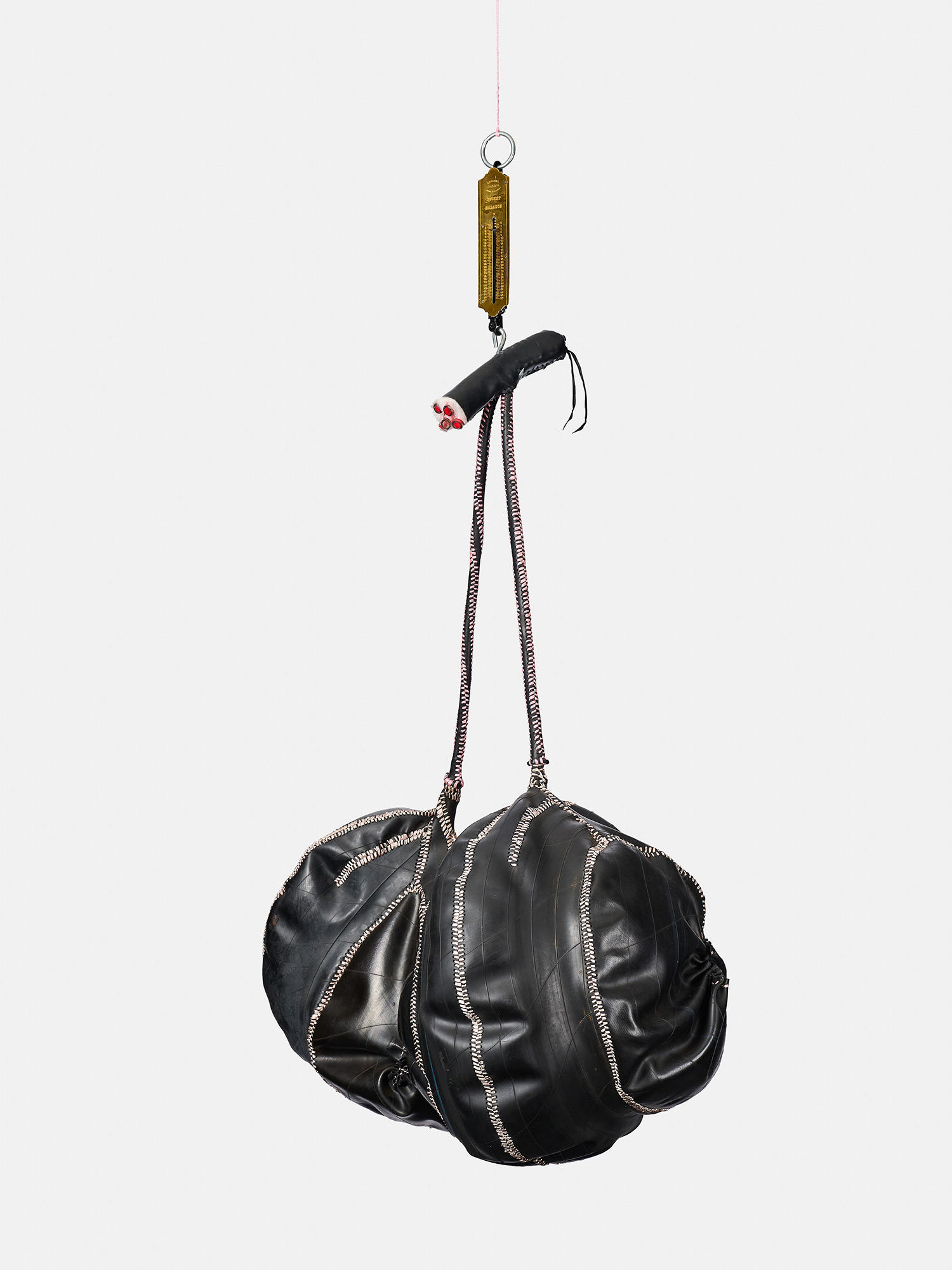
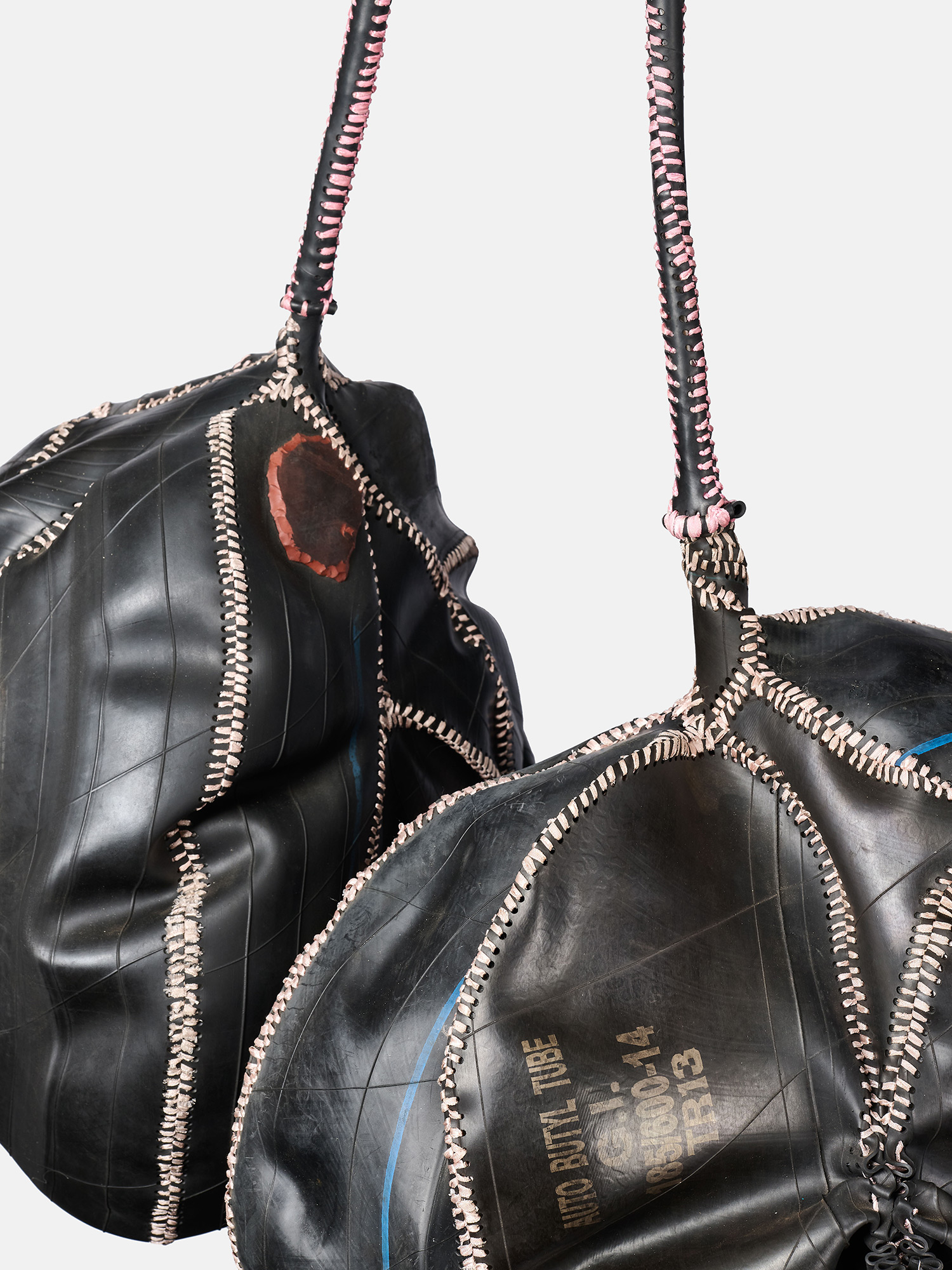
Isisindo samadlozi
2006
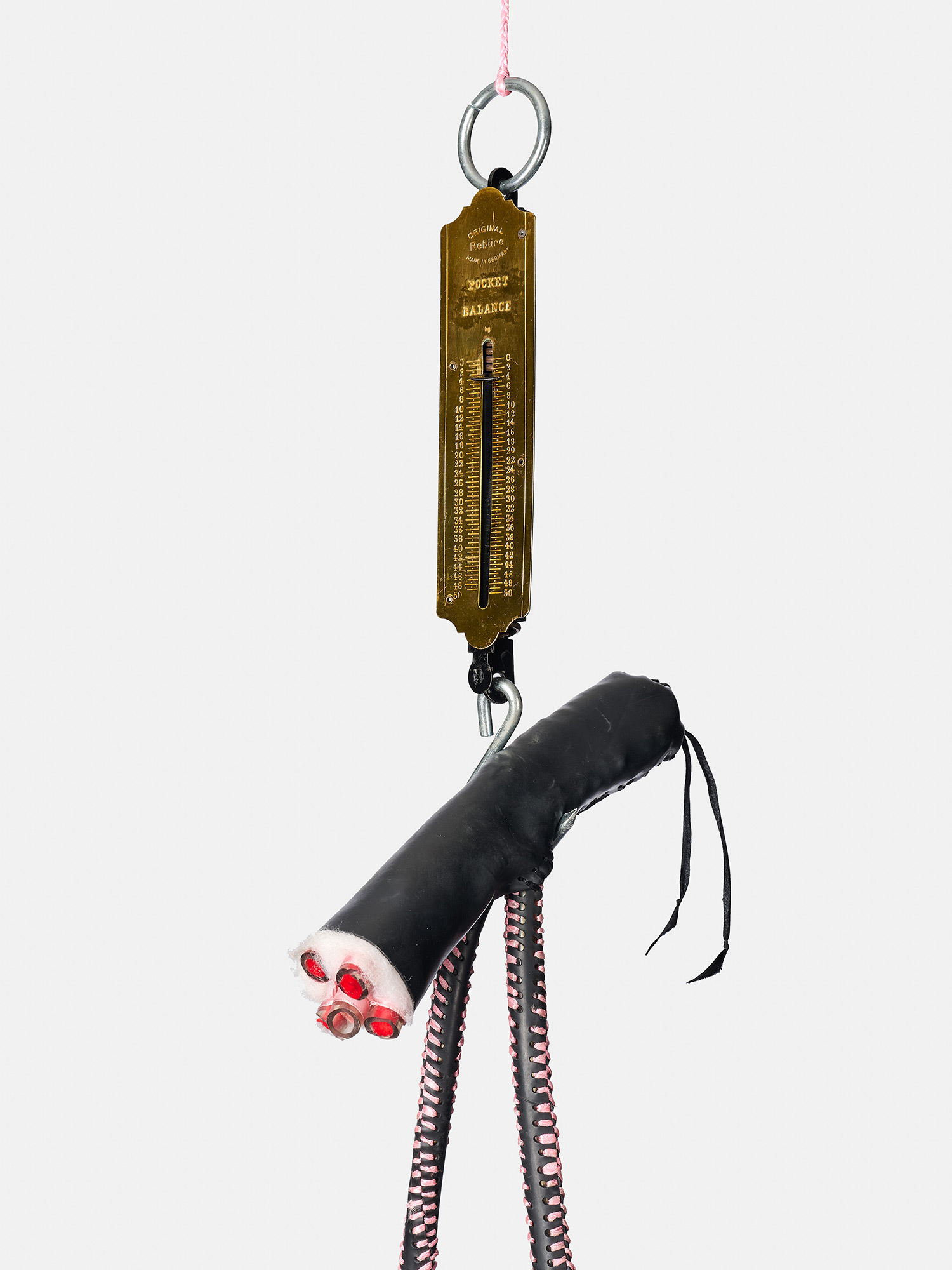
rubber inner tube, scale, ribbon, plastic tube, fabric
225 x 90 x 60 cm (variable)
In his artist statement about this work, Hlobo writes:
Isisindo means ‘the weight’. Idlozi is an Nguni word, but in Zulu it means the ancestors. Most people read this as ‘the weight of the ancestors’. But in Xhosa idlozi means the sperm. The verb is ukudloza which means ejaculate, or reaching a climax. So it’s a word that people don’t like using in front of children. This is playing with that Nguni word, idlozi. Isisindo samadlozi – the weight of the sperms.
I’ve made these two balls and an amputated phallus-like shape. It could be a dildo, or the gear stick of a car, if you look at the stitching. The rubber that covers it looks like a sheath. And it’s suspended on a scale. I was thinking about someone going to an old general dealer in the countryside or the township, where you get anything from needles to food – you get your shoes there, your jacket … You’d get some beans or grain and you’d weigh it using the scale. Even fishermen could use this scale. You would get the scale in a butchery. And these balls, the whole structure, looks to me like something that is butchered. The reason I thought of something being butchered is because of the problems we have around male circumcision in Xhosa culture. Some boys have to go to hospital because of botched circumcision. The penis part is cut. I used red ribbon there to suggest veins, blood that is flowing through. I went rough on it, like an inexperienced surgeon.
The balls – you think it’s a scrotum, but at the same time it looks skinned. I was playing with the idea of something… Continue Reading
BIOGRAPHY
Nicholas Hlobo was born in Cape Town and currently lives and works in Johannesburg. He graduated with a degree in Fine Art from the Technikon Witwatersrand in Johannesburg in 2002.
Using tactile materials such as ribbon, leather, wood and rubber detritus that he melds and weaves together, Hlobo creates intricate two- and three-dimensional hybrid objects. Each material holds a particular association with cultural, gendered, sexual or ethnic identity. His evocative, anthropomorphic imagery and metaphorically charged materials elucidate the artist’s own multifaceted identity within the context of his South African heritage.
Hlobo received a fine art degree from Johannesburg’s Technikon Witwatersrand in 2002.
His first solo exhibition, Izele, was held at Stevenson, Cape Town in 2006. Soon afterwards, he shot to global recognition with Uhambo, his 2008 solo show at Tate Modern, London.
Other solo exhibitions have taken place at institutions including the Uppsala Konstmuseum (2017); Museum Beelden and Zee in The Hague (2016); Locust Projects in Miami (2013); the National Museum of Art, Architecture and Design in Oslo (2011); and the Boston ICA, as part of the Momentum series (2008).
He won the Tollman Award for Visual Art (2006), the Standard Bank Young Artist Award for Visual Arts (2009). In 2010, he was the recipient of the Rolex mentor and protégé arts initiative with a mentorship by Indian British artist Anish Kapoor. Hlobo was also the first recipient of the Villa Extraordinary Award for Sculpture in 2016. His works have made their way into the Pinault Collection at the Palazzo Grassi, and the Palazzo Papadopoli as part of the Future Generation Art Prize, established by the Victor Pinchuk Foundation.
Hlobo has participated in several biennales including the 18th Biennale of Sydney, Australia (2012), 54th Venice Biennale (2011), 6th Liverpool Biennial (2010) and 3rd Guangzhou Triennial, China (2008).
His work is included in numerous international public and private collections, including Tate Modern, London; The Metropolitan Museum of Art, New York; Fondation Louis Vuitton, Paris; Savannah College of Art and Design (SCAD) Museum of Art, Savannah; Detroit Institute of Arts, Detroit; and the Zeitz Museum of Contemporary African Art, Cape Town.